Study Abroad Program US Universities: A 2026 Guide for International Students
If you're searching for a study abroad program at U.S. universities, you have several paths: undergraduate degrees, graduate programs, community colleges, short-term academic programs, and English-language study. The right option depends on your academic background, budget, career goals, preferred location, and eligibility for a U.S. student visa.
The United States remains one of the world's largest destinations for international education. According to the Open Doors 2025 report, U.S. colleges and universities hosted 1,177,766 international students during the 2024/25 academic year, representing a 5% increase from the previous year.
For prospective students, however, choosing a university is only the beginning. You also need to compare programs, estimate total costs, prepare your application, secure funding, obtain the appropriate immigration documents, and prepare for the visa process.
Key Takeaways
- U.S. universities offer programs at multiple levels, including undergraduate, graduate, non-degree, and English-language study.
- Program fit matters more than university name alone. Compare curriculum, tuition, location, career outcomes, and admission requirements.
- International students should create a complete budget, including tuition, housing, food, health insurance, transportation, and required fees.
- Scholarships and institutional financial aid may reduce the overall cost, but availability and eligibility vary by university.
- Most international students pursuing academic degrees use the F-1 student visa.
- You generally need admission to an SEVP-approved school before completing the student-visa process.
- Application timelines should be planned months ahead of the intended start date.
What Is a Study Abroad Program at a U.S. University?
A study abroad program in the United States can refer to several types of educational opportunities.
For international students, the most common option is enrolling directly in a U.S. college or university for a degree. Other possibilities include exchange programs, short-term academic programs, professional programs, and English-language programs.
EducationUSA, the U.S. Department of State's official source for information about U.S. higher education, identifies several study options for international students, including community college, undergraduate, graduate, short-term, English-language, and online learning.
Common Study Options
Undergraduate programs
These generally lead to a bachelor's degree and typically take about four years, although the timeline can vary by program and institution.
Graduate programs
International students can pursue master's degrees, doctoral degrees, and other graduate-level qualifications. In 2024/25, graduate students represented the largest academic-level group among international students in the United States, with 488,481 students.
Community colleges
Community colleges can provide associate degrees and other educational pathways. Some students use community colleges as part of a transfer pathway to a four-year university.
Short-term programs
EducationUSA describes short-term U.S. programs as programs lasting 12 months or less, including university exchanges, professional non-degree programs, and internships.
English-language programs
Intensive English programs can be useful for students who want to improve their academic or professional English. In 2025, more than 66,000 international students studied through intensive English programs in the United States.
Why Do International Students Choose U.S. Universities?
The U.S. higher-education system offers a broad range of institutions and academic disciplines.
In 2024/25, 57% of international students in the United States studied STEM fields, while math and computer science represented 26% and engineering represented 18%. Business and management accounted for another 14%.
This variety can be particularly relevant for students interested in areas such as:
- Computer science
- Data science
- Artificial intelligence
- Engineering
- Business and finance
- Healthcare
- Economics
- Information technology
- Cybersecurity
- Environmental science
- Public policy
The important point is that there is no single "best" U.S. university for every student. Your objective should be to find a university and program that match your academic profile, financial resources, career objectives, and preferred learning environment.
How to Choose the Right U.S. University
Choosing a university based solely on rankings can create problems later. A better approach is to evaluate the entire student experience.
1. Start With Your Academic Goal
Define what you actually want to study.
For example, a student interested in technology might compare computer science, software engineering, information systems, data science, and artificial intelligence programs rather than searching only for universities with famous names.
Look at:
- Degree requirements
- Course curriculum
- Specializations
- Research opportunities
- Internship opportunities
- Faculty expertise
- Graduation requirements
- Career resources
2. Compare Total Costs
Tuition is only one part of the cost of studying in the United States.
Your budget may need to include:
- Tuition
- University fees
- Housing
- Food
- Health insurance
- Books and supplies
- Local transportation
- Airfare
- Visa-related expenses
- Personal expenses
EducationUSA specifically recommends evaluating finances early because tuition and living expenses vary significantly across U.S. locations and institutions.
Location can make a substantial difference. Housing and everyday expenses in a major metropolitan area can be very different from costs in a smaller city or college town.
3. Check International Student Support
Look for universities with resources that can help international students adapt academically and socially.
Useful services may include:
- International student offices
- Academic advising
- Career services
- Orientation programs
- English-language support
- Internship and career preparation
- Immigration advising through the university's designated officials
4. Verify Admission Requirements
Admission requirements differ between universities and programs.
Depending on the school and degree level, you may need:
- Academic transcripts
- Diplomas or degrees
- English proficiency scores
- Standardized test scores, when required
- Letters of recommendation
- Statement of purpose or personal statement
- Resume or CV
- Portfolio for selected programs
- Application fee
- Financial documentation
Never assume that one university's requirements apply to every U.S. university.
How Much Does It Cost to Study at a U.S. University?
There is no single nationwide price for studying in the United States.
Your total annual cost depends on the university, degree, state, city, housing arrangement, and lifestyle.
Instead of asking only, "How much is U.S. university tuition?", build a complete annual budget.
A Simple U.S. Study Budget
| Expense | What to Consider |
|---|---|
| Tuition | Program and institution-specific |
| University fees | Academic and student-service charges |
| Housing | Campus or off-campus accommodation |
| Food | Meal plan or personal grocery budget |
| Health insurance | University or approved insurance requirements |
| Transportation | Public transit, campus transportation, or car expenses |
| Books | Course materials and technology |
| Visa expenses | Application and related fees |
| Travel | Flights and local transportation |
| Personal expenses | Phone, clothing, entertainment, etc. |
The U.S. Department of State currently lists the nonimmigrant visa application processing fee for F-category student visas at $185. Other costs can apply depending on circumstances and nationality.
Because prices and university fees change, students should always use the university's current cost-of-attendance information rather than relying on an old blog post or social-media estimate.
Scholarships for International Students in the USA
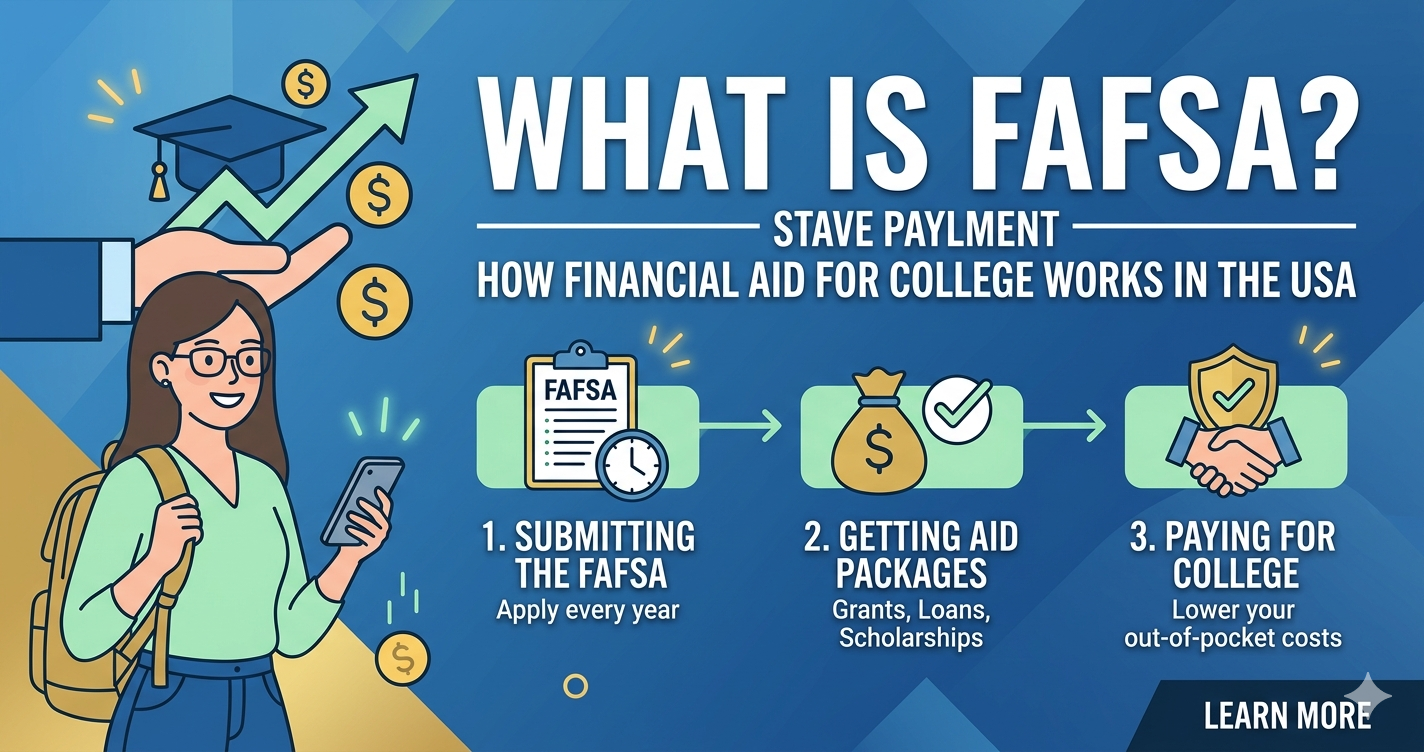
Scholarships can make a significant difference, but students should treat financial aid as part of the application strategy—not something to investigate after receiving admission.
EducationUSA notes that U.S. institutions offer different forms of financial assistance and opportunities, including scholarships, tuition benefits, application-fee waivers, and other provisions. It also emphasizes that competition can be high.
Potential funding sources include:
- University merit scholarships
- Department-specific scholarships
- Graduate assistantships
- Research assistantships
- Teaching assistantships
- Tuition waivers
- External scholarships
- Government-sponsored scholarships
- Need-based institutional aid where available
A Better Scholarship Strategy
Instead of applying randomly, create a spreadsheet containing:
University → Program → Scholarship → Eligibility → Amount → Deadline → Required Documents
This makes it easier to prioritize opportunities and avoid missing deadlines.
EducationUSA also maintains a searchable database of financial-aid opportunities for international students.
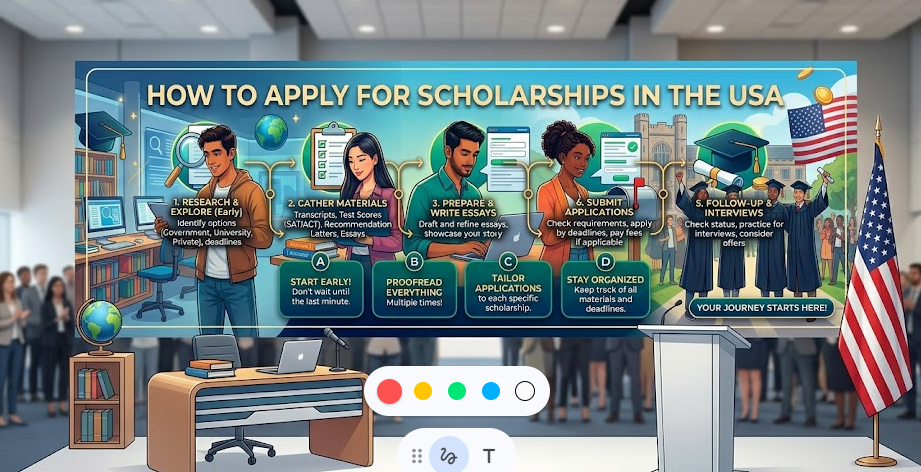
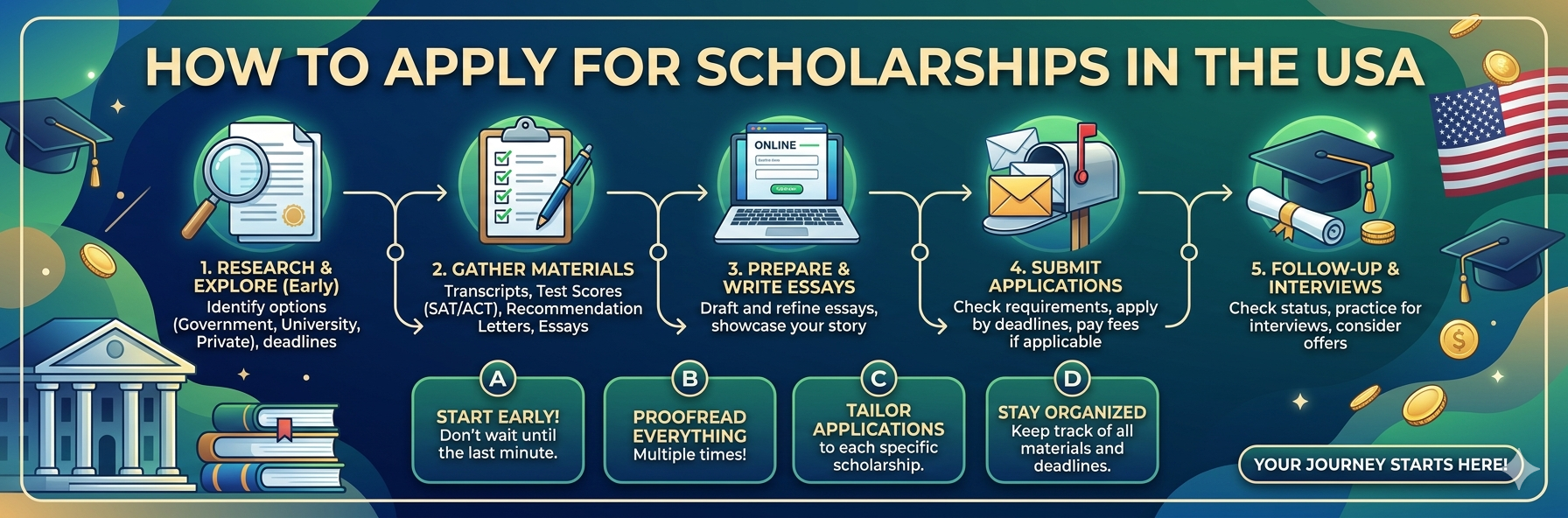
U.S. University Application Process: Step by Step
A strong application is usually the result of preparation rather than last-minute submission.
Step 1: Define Your Target
Decide:
- Degree level
- Major
- Preferred states
- Budget
- Target intake
- Academic goals
- Career goals
Step 2: Build a University Shortlist
Create three groups:
Reach: Universities where admission may be more competitive based on your profile.
Target: Universities where your academic background appears reasonably aligned with published requirements.
Financial fit: Universities where the overall cost is compatible with your available funding and potential financial aid.
This is not a prediction of admission. It is simply a practical way to diversify your application list.
Step 3: Review Requirements
Visit each university's official admissions page and confirm the current requirements.
Do not depend exclusively on third-party websites for deadlines or test requirements.
Step 4: Prepare Your Documents
Start preparing transcripts, recommendation letters, essays, test scores, financial documents, and other materials early.
If documents are not in English, check whether the university requires certified translations.
Step 5: Submit Applications
Follow each university's application instructions carefully.
Some schools use centralized application systems, while others require applications through their own platforms.
Step 6: Compare Admission Offers
If you receive multiple offers, compare:
- Net tuition
- Scholarship amount
- Total estimated cost
- Program curriculum
- Location
- Housing
- Career resources
- Internship opportunities
- University support services
The lowest published tuition is not necessarily the lowest total cost.
F-1 Student Visa: What International Students Need to Know
For most international students attending a U.S. university for academic study, the relevant category is the F-1 student visa.
The U.S. Department of State states that students must first be accepted by an appropriate school. For academic study, the school must be SEVP-approved, and the institution issues a Form I-20 after the student is registered in SEVIS.
The basic sequence is:
- Apply to a U.S. university or eligible school.
- Receive admission.
- Receive the Form I-20.
- Register/pay the applicable SEVIS-related fee.
- Complete the DS-160.
- Schedule the visa interview according to the applicable U.S. Embassy or Consulate instructions.
- Prepare the required documentation.
- Attend the interview.
- If approved, prepare for travel and entry.
The State Department currently lists the F-1 visa application fee as $185.
A visa does not itself guarantee admission into the United States; final admission at the port of entry is determined by U.S. Customs and Border Protection.
What Documents May Be Required?
Students should generally prepare documents such as:
- Valid passport
- DS-160 confirmation
- Form I-20
- Visa fee receipt, where applicable
- Academic records
- Test scores, if applicable
- Financial evidence
- Scholarship documentation, if applicable
- Additional documents requested by the consular officer
The exact documentation can vary based on the student's circumstances and the embassy or consulate processing the application.
What About Working in the United States After Graduation?
Employment options for international students depend on immigration rules, the student's status, the degree program, and applicable authorization.
One important program is Optional Practical Training (OPT). The U.S. Department of State describes OPT as temporary employment directly related to an eligible F-1 student's area of study, subject to applicable authorization requirements.
Open Doors reported 294,253 international students on OPT in 2024/25, a 21% increase from the previous year.
Students should not treat OPT as an automatic pathway to permanent employment or immigration status. Eligibility and future options depend on the applicable rules and individual circumstances.
Practical Study Abroad Checklist
Before submitting your first application, use this checklist:
Academic Preparation
Choose your intended major
Review university requirements
Collect transcripts
Check English-language requirements
Determine whether standardized tests are required
Prepare your resume/CV
Identify recommendation-letter writers
Financial Preparation
Calculate tuition
Estimate housing costs
Estimate food and transportation
Research scholarships
Prepare proof-of-funding documents
Budget for application and visa-related costs
Keep an emergency fund
Visa Preparation
Confirm the school is appropriate for your intended student status
Receive your Form I-20 after admission
Complete required SEVIS steps
Complete DS-160
Review embassy/consulate instructions
Prepare for the visa interview
Before Departure
Arrange housing
Purchase required health insurance
Book travel after appropriate visa approval
Organize original academic documents
Save digital copies of important documents
Review university orientation information
A Realistic Example
Consider an international student who wants to pursue a master's degree in data science.
Instead of immediately applying to the most recognizable universities, the student could first define a budget and compare 8–12 programs based on curriculum, tuition, location, admission requirements, financial aid, and career resources.
The student could then narrow the list, prepare a customized statement of purpose, request recommendations, submit applications before deadlines, and separately prepare the financial and visa documentation required after admission.
This approach creates a repeatable application system rather than treating university admission as a single application.
FAQ: Study Abroad Programs at U.S. Universities
What is the best study abroad program for international students in the USA?
The right U.S. study program depends on your degree level, academic background, career objectives, budget, and preferred location. Students should compare programs by curriculum, total cost, admission requirements, financial aid, university support, and career opportunities rather than choosing solely by university reputation.
How much money do I need to study at a U.S. university?
There is no universal amount because U.S. tuition and living expenses vary substantially by institution and location. Students should calculate tuition, university fees, housing, food, insurance, transportation, books, travel, and personal expenses. EducationUSA recommends evaluating finances early when planning U.S. study.
Do international students need an F-1 visa to study at a U.S. university?
Generally, international students pursuing academic study at a U.S. university need an F-1 student visa. Students normally first obtain admission to an SEVP-approved school, receive a Form I-20, complete the required SEVIS process, and then apply for the student visa.
Can international students get scholarships at U.S. universities?
Yes. Some U.S. universities offer scholarships and other forms of financial assistance to international students, although eligibility and award amounts vary considerably. Students should research funding opportunities at the same time they research university admission requirements and deadlines.
Start Planning Your U.S. University Journey
A successful study abroad program at a U.S. university starts well before you submit an application. The strongest applicants typically begin with a clear academic goal, realistic financial plan, carefully researched university list, organized documentation, and an understanding of the student-visa process.
The United States continues to attract students across undergraduate, graduate, STEM, business, and other academic fields. Open Doors reported nearly 1.2 million international students in U.S. higher education during 2024/25, demonstrating the scale and diversity of the U.S. international education market.
If you're evaluating U.S. university opportunities and need help organizing your education-planning journey, explore the resources and services available from EICL Services and take the next step toward a well-planned U.S. study application.
Important: U.S. university requirements, tuition, deadlines, visa procedures, and immigration rules can change. Always confirm current requirements with the university and official U.S. government sources before submitting an application or making travel arrangements.