For many students, studying in the United States feels out of reach. Tuition fees are high, living costs are higher, and the competition is global.
Yet every year, thousands of international students—including many from South Asia—manage to study in the USA on scholarships.
What’s changing is not just opportunity, but awareness.
Students are becoming more strategic.
A recent graduate from Dhaka, who is now preparing to begin his master’s degree in the U.S. with partial funding, described his journey simply:
“I didn’t have extraordinary results. But I learned how to apply properly. That made the difference.”
His experience reflects a broader pattern—success often comes down to understanding the process, not just academic performance.
A growing range of scholarship opportunities
The USA offers a wide range of scholarships, but many students only know a few names.
Among the most recognized is the Fulbright Program, a fully funded initiative that supports international students pursuing graduate studies. It covers tuition, travel, and living expenses, making it one of the most competitive options.
At the university level, institutions like Harvard University offer need-based financial aid that can cover up to 100% of costs for eligible students. Similarly, Stanford University and Massachusetts Institute of Technology provide generous funding packages, often without requiring separate scholarship applications.
There are also lesser-known private and departmental scholarships that receive far fewer applications but offer meaningful support.
What the application process really requires
Despite the variety of scholarships, the core requirements remain largely the same.
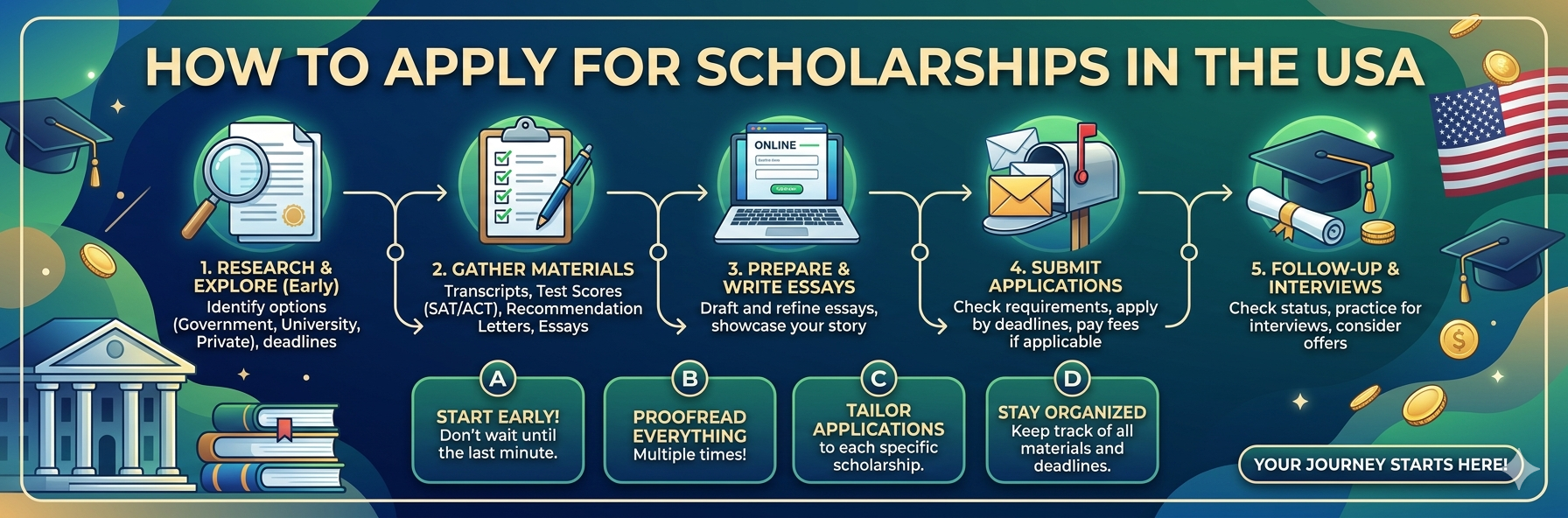
Students are typically asked to submit academic transcripts, English proficiency scores such as IELTS or TOEFL, a Statement of Purpose, recommendation letters, and a CV. In some cases, a separate scholarship essay is also required.
What often separates successful applicants is not the documents themselves, but how they are prepared.
A former scholarship recipient, now studying in the U.S., explained it this way:
“Everyone submits documents. But not everyone tells a clear story. That’s where most people lose.”
How successful applicants approach the process
Unlike first-time applicants who apply randomly, successful students tend to follow a more structured path.
They begin with focused research—identifying scholarships based on their field of study, academic level, and eligibility. University websites remain one of the most reliable sources of information.
Eligibility is treated seriously. GPA requirements, test scores, and country-specific criteria are carefully reviewed before applying. This alone helps avoid unnecessary rejections.
When it comes to documents, particularly the Statement of Purpose, students who succeed tend to write in a way that reflects their personal journey rather than relying on generic templates.
The role of the scholarship essay
The scholarship essay continues to be one of the most decisive parts of the application.
While many applicants try to impress with complex language, successful essays are often simple, direct, and personal.
They answer three basic questions:
- What are your goals?
- Why does this scholarship matter to you?
- What have you done so far to reach this point?
Admissions reviewers are not looking for perfection—they are looking for clarity and intent.
Timing and consistency matter
Most major scholarship deadlines in the USA fall between October and January for Fall admissions, with some extending into March or May.
Students who begin preparing at least six months in advance tend to perform better, as they have time to refine their documents and avoid last-minute errors.
Applying early also reduces pressure and allows room for corrections.
What increases your chances
There is no guaranteed formula for success, but certain patterns are clear.
Students who secure scholarships often:
- Apply to multiple programs instead of relying on one
- Balance high-competition and lower-competition options
- Customize their applications instead of copying content
- Continue applying even after initial rejections
In contrast, many unsuccessful applications fail due to simple, avoidable mistakes—missing deadlines, incomplete submissions, or ignoring eligibility criteria.
Starting small can make a difference
Experts often advise new applicants to begin with less competitive scholarships.
These may include:
- University-based partial funding
- Automatic consideration scholarships
- Smaller private awards
While these may not be fully funded, they provide valuable experience and increase confidence for future applications.
A shift in mindset
The idea that scholarships are only for “top students” is gradually changing.
What matters more is preparation, clarity, and persistence.
As one student put it:
“It’s not about being the best. It’s about not giving up after the first rejection.”